Aligning Colorado’s Education-to-Workforce Ecosystem
Centering Human Experience, Leveraging Technology Efficiencies, and Advancing Policy Enablers
When I moved to Colorado in 2008, unbeknownst to me, recently passed legislation establishing the Colorado Achievement Plan for Kids (commonly known as CAP4K) formally began Colorado’s ongoing quest to create education-to-workforce alignment. Fast-forward 18 years, Colorado has made major investments in career-connected learning, credential pathways, and workforce development. Yet learners still face fragmented systems that make it difficult to translate education into meaningful employment.
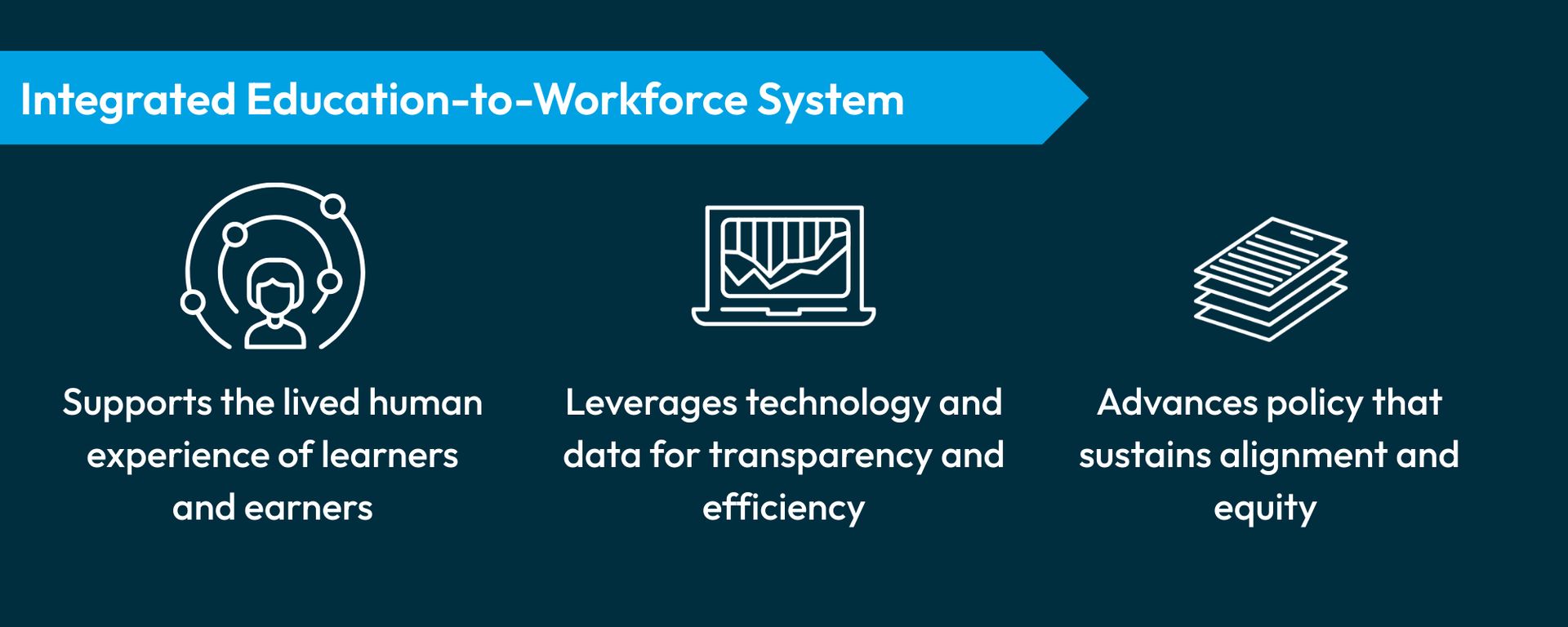
I’ve had the chance to work in policy development, statewide implementation, local implementation in districts and postsecondary institutions, and direct learner engagement. These experiences highlight the need for an integrated system built on three equally important components:
- Supporting the lived human experience of learners and earners
- Leveraging technology and data for transparency and efficiency
- Advancing policy enablers that support and sustain alignment and equity
Supporting the Lived Human Experience:
My time at the Denver Scholarship Foundation was a daily reminder that at the center of every workforce strategy is a person navigating education, employment, financial realities, individual values, and career identity. Systems that fail to prioritize learner experience often produce strong programs that learners struggle to access or complete. Career advising, stackable credentials, and credit transferability are critical strategies that prioritize learner experience by producing strong programs that learners can both access and complete.
1. Career advising is the system’s connective tissue, helping learners understand their options, explore their sense of purpose, align education with career goals, and navigate transitions across systems. Strong advising supports learners by:
- Providing a trusted thought partner to collaborate on identifying next steps through connection to accurate and reliable resources, and removing perceived barriers to success
- Translating relevant labor market information into actionable career pathways
- Helping learners select credentials aligned to short-term needs and long-term goals
- Supporting smooth transitions between secondary, postsecondary, and workforce systems
- Understanding and leveraging social capital
- Building a sense of purpose, belonging, confidence, and career identity
2. Stackable credentials allow learners to earn meaningful credentials incrementally while working toward long-term career and education goals. Colorado has emerged as a national leader in stackable credential development. The state has created multiple sector-based credential pathways aligned with high-demand occupations and supported by legislation requiring institutions and employers to collaborate on credential design. Stackable credentials support the lived human experience by allowing learners to progress at their own pace, earn credentials with immediate labor market value, and return to education without losing prior achievements.
3. Credit transferability significantly affects learner persistence and affordability and is essential for maximizing the benefits of stackable credentials, ensuring that certificates and work-based learning experiences can contribute toward higher-level degrees. Colorado’s policy supports the one-third of learners who transfer by providing innovative options for learners, including:
- Expansion of credit for prior learning
- Allowing bachelor’s degree granting institutions to confer associate degrees to students who transferred from a two-year institution to a four-year institution by combining credits earned at each institution
- Mandating transparency for learners on how and why their credits are accepted and applied or rejected
- Developing a Colorado Transfer website to support a more transparent, efficient and learner-friendly transfer process
A recent audit of Colorado’s transfer system emphasized further opportunities for clarity, oversight, and consistent implementation of transfer practices to ensure all learners can fully benefit from the state’s transfer policies.
Leveraging Technology and Data Efficiencies: Over the years, I’ve heard countless frustrations from learners, advisors, district leaders, postsecondary administrators, and policymakers about navigating the complex education-to-workforce system. Nine times out of 10, these frustrations can be narrowed down to one thing — lack of or limited access to trusted, reliable information. What I would have given for an integrated statewide data system that was accessible, understandable, and actionable.
This data infrastructure is needed to scale and sustain the learner-centered advising and pathway designs above. It will provide data supporting credential quality and development of career pathways, allow for the evaluation of credential outcomes, align training with workforce needs, and improve program design. It would also allow for learner advising and navigation systems connecting individual experiences, skills, and priorities with relevant training, credential, and workforce data.
Data-driven decision-making enables:
- Advisors to provide evidence-based guidance
- Institutions to improve program quality
- Policymakers to invest in high-value credentials
- Learners to make informed education and career decisions
Colorado has made significant progress toward building a centralized Statewide Longitudinal Data System (SLDS). The SLDS connects education and workforce data across agencies, a tangible resource that will enable stakeholders to track outcomes across a learner’s educational and employment journey. The system will serve as a public good, designed to help individuals and policymakers make informed decisions and address opportunity gaps across communities.
Policy Enablers That Sustain Alignment: Fun fact: When I worked at the Colorado Department of Education 10 years ago, I was in the Office of Postsecondary Readiness — it’s now called the Office of Postsecondary and Workforce Readiness. This evolution of language coincided with evolving policies to better align the education-to-workforce ecosystem.
Colorado has been building supportive policy frameworks to enable and sustain the human-centered design and data infrastructure outlined above. This has included:
- Legislative and funding alignment advancing credential attainment and pathway design by requiring collaboration between higher education institutions and industry partners, provided investments in stackable credential development, and incentivized priority outcomes of work-based learning, industry recognized credentials, and college credit through accountability and funding mechanisms.
- Cross-sector governance and collaboration via initiatives such as regional workforce partnerships, Opportunity Now grants, and the Governor’s recent order to create a unified postsecondary talent development system.
- Accountability and transparency through data modernization efforts and credential evaluation frameworks supporting data as a public good, helping learners understand the economic value of education pathways and policymakers identify effective programs.
The Integrated Model: How These Policies Areas Reinforce Each Other
When I picture Colorado’s future integrated education-to-workforce ecosystem, I see individualized advising that helps learners select stackable credentials, transferability that ensures those credentials retain value, and accessible data that validates pathway effectiveness and provides learners with actionable information.
Colorado’s education-to-workforce system functions best when these policy areas operate together.
- Career advising role of supporting human navigation helps learners understand pathways and make informed decisions
- Stackable credentials allow for flexible pathway design which builds accessible and workforce-aligned learning options
- Credit transferability provides structural continuity ensuring learners retain progress across transitions
- Effective use of data and technology strengthens systems intelligence by measuring outcomes, improving programs, and clear decision-making tools
Colorado has built strong momentum toward an integrated education-to-workforce system. Sustaining this progress requires continued investment and leadership to maintain balance across lived human experience, technology infrastructure, and policy alignment. Together, these pillars can ensure that every learner and earner has access to pathways that lead to meaningful careers and long-term economic mobility.
RECENT ARTICLES