Helping Every Learner and Earner Navigate Toward Success
A Q&A with Michelle and Katherine
Early in 2026, The Attainment Network launched an initiative focused on what quality career advising looks like across systems and what learners, earners, and practitioners need for it to work. As education partners across the state are working to improve alignment between K-12, postsecondary, and workforce — including the Big 3, reimagining a postsecondary talent development system, and related career-connected learning needs — we set out to develop learning resources that will support career advising systems that help every learner and earner navigate toward a life they define as successful.
We are incredibly grateful to the following partners for learning with us on this journey: Boys & Girls Clubs of the San Luis Valley, Community College of Aurora, Denver Public Schools, Jeffco Public Schools, Rocky Mountain Partnership, and San Luis Valley BOCES.
We began by gathering partners and conducting a landscape analysis, and last month we reported on the learnings so far and checked in with partners to pressure test our findings based on their experience.
From the research, several themes emerged:
- Effective career advising is relational, personalized, and continuous.
- Advising must be integrated within and between education and workforce systems.
- Current state priorities, like the Big Three, provide an opportunity to meaningfully strengthen how career advising and navigation is defined, measured, and operationalized.
- Learner voice was one of the most important and underdeveloped areas in the literature.
- Technology and data systems represent both a major opportunity and a growing challenge with a need for greater interoperability; however, the ultimate need is to better align technology with human-centered advising practices.
We sat down with Michelle Camacho Liu, Director of Partnerships and Systems Strategy, and Katherine Stewart, Director of Partnerships and Engagement — our co-leads on the Career Advising & Navigation initiative — to explore their goals for the project and what they’ve learned so far.
Q: What was the moment when you realized we have a real gap in our career advising systems? What were you seeing that you think others were overlooking?
Michelle:
Even before I started working for The Attainment Network, I noticed a gap in the support learners were receiving. While practitioners were incredibly passionate about their work, about student well-being, and about taking a whole-student approach, when “careers” entered the conversation, it felt like one more thing was added to their already full plate. Career conversations were even seen by some as minimizing learners' goals to “only” a career, rather than something naturally connected to the work they were already doing.
I started trying to understand where that was coming from and thinking about what an individual really needs during their time in an education setting. I kept coming back to this idea that knowledge is power. If we are passionate about supporting people to better understand themselves and what their “why” is, are we not doing a disservice if we fail to understand how a career fits in?
Q: Katherine, anything you would add?
Katherine: Michelle, that’s such a great jumping-off point. When we think about learners’ definitions of success, we have to think not only about how individuals define success for themselves, but whether they’re actually given the space and invitation to intentionally define it. Otherwise, people can end up anchoring themselves to a particular job because they know somebody who does it, or leaning into the trend of the moment.
As an intermediary, The Attainment Network has the benefit of working in deep partnership with organizations across education and workforce — K-12, postsecondary, workforce and industry. That allows us to see the systemic challenges and opportunities of career advising and navigation across an individual’s whole life.
Our partners may see different segments of that experience. Where we can really contribute is by bringing together the learning from those partners, connecting the dots across transitions, and building a more robust picture of what people might need over the course of their lives.
An individual’s definition of success at 18 may be different from their definition at 36 or later in life. It’s an ongoing meaning-making process.
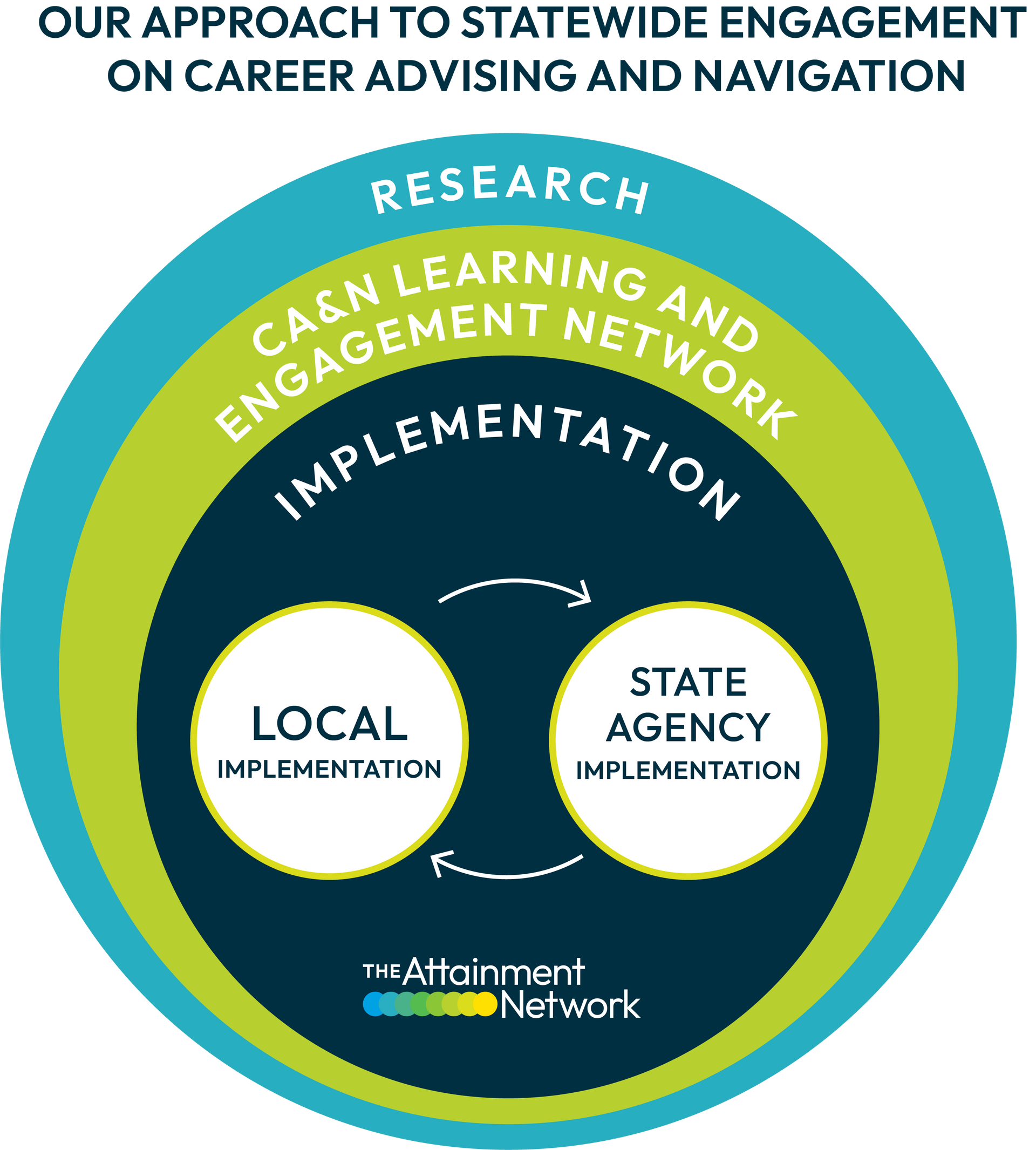
Q: The Attainment Network has taken a multi-fold approach to understanding career advising and navigation systems: local implementation projects, alignment with state agencies, cultivating a network of subject-matter experts and practitioners, and grounding it all in a robust landscape analysis of existing state tools and national frameworks. Six months in, how are learnings across these areas coalescing?
Katherine: First, I want to emphasize that our learnings are preliminary, and the work is ongoing. We have partners who are six months into two-year projects, and their findings will directly inform how we iterate and deepen our work. That said, we’re seeing strong signals in the following spaces: understanding criteria of quality in career advising and navigation practices; strengths and challenges around staffing models/professional development for practitioners and data systems and integration; and the importance of infusing concepts like purpose, belonging, and social capital development into existing spaces where learners and earners are making sense of their education and career journeys.
Michelle: We’re also seeing strong alignment between what we’re learning locally and the state and national work around career advising and navigation. Working across those levels allows us to identify opportunities for greater alignment and to test what actually resonates with practitioners and partners as they put these ideas into practice.
One thing that is becoming increasingly clear is that the gap isn’t necessarily a lack of information, frameworks, or resources. There is a lot out there. The challenge is helping people make sense of what exists, identify which tools and approaches are most relevant to their particular context, and translate research and policy into effective implementation. That sense-making and translation between what we know and how the work actually gets done is an important role we see for The Attainment Network.
Q. The Attainment Network knows that complex problems require working in partnership. Who is helping you shape this work, and how have their perspectives changed your thinking so far?
Michelle: We’re learning alongside regional partners, school districts, community colleges, workforce organizations and state agencies — not coming in with a predetermined answer.
Our role is to look across those different contexts, identify common threads and connect partners with ideas, research and one another in ways that help move the work forward. Because we work across regions and systems, we can bring a broader perspective to the challenges partners are navigating locally while continuing to refine our own thinking based on what they’re learning.
Katherine: And the benefit of working in deep partnership is that we can build on what’s already working rather than recreate the wheel. As we’ve mentioned, our partners are tackling these challenges every day; we can see in real time how partners are integrating career-connected learning and advising, learn alongside them and then pressure-test what we’re learning across different communities and settings.
One thing that has stayed with me came through our statewide questionnaire on career advising and navigation models. Some respondents told us, “I think we actually do these specific things really well,” and they were willing to give us a real inside look.
These were leaders from K-12, postsecondary, workforce, community-based organizations and the state, serving a wide variety of learners and earners.
The people who could really articulate, “This is our model, and this is why we do it this way,” were better able to answer our questions and had a deeper sense of their organizational “why.” It may sound basic, but having a clear picture of your process – strengths, gaps, and outcomes – is a pretty good first step toward being able to improve and deepen your practice.
Q: Going back to your point about purpose, belonging, and social capital development, you’ve found places that are working effectively to incorporate these concepts. What makes those efforts different?
Michelle: As in any strategy or process improvement effort, one thing that matters is whether people have the ability to iterate and try things in different ways. That ability can be a privilege because it requires time and capacity.
This is even more critical in operationalizing the meaningful integration of purpose, belonging, and social capital into a career advising & navigation strategy. These are not new concepts, but how they are incorporated into formal advising spaces must take into consideration a much more individualized approach. Definitions of opportunity and success within purpose, belonging, social capital are as varied as the individuals being served.
With this in mind, you may not be able to change an entire program or organization at once, but perhaps you can try something with a smaller group and see what you learn. You can take small, iterative steps and use them as stepping stones toward going deeper.
What I’ve seen work particularly well is when leaders and the people developing strategy work closely with the people who have one-on-one connections with learners and earners to shape strategy. This requires time, capacity and leadership.
When leadership, practitioners and learners come together, that’s when I think the work really moves forward.
Katherine: Organizations that create space for reflection — or make reflection an unavoidable part of the process — will be better positioned to understand how they’re doing in this area.
Q: If this work succeeds beyond your expectations, how do you think a learner’s experience will be different five years from now?
Katherine: I think about the opportunity to build connective tissue and a more cohesive education and workforce system, particularly at those transition points.
Learners would be able to answer questions like: Who am I? Where do I want to go? Who can help me get there? Those are questions about self-exploration and generating options. Learners will feel supported and have greater confidence and clarity about where they’re headed and how to get there.
But practitioners also need access to the information, tools, and resources that allow them to support those conversations. For all the ways we talk about embedding technology, there is still a really important human aspect to this work. Practitioners need the confidence and expertise to help learners make sense of their options and guide them to and through each new phase of their education-to-career journey.
If it’s a one-on-one setting, we need to think about both people in that interaction. How do we make sure the infrastructure supports what is ultimately still a very human experience?
Michelle: For me, success would mean learners and earners don't feel like they have to start over every time they move to a new institution, advisor or stage of life. They would be able to build on what they've already learned about themselves and their goals, know what questions to ask and know who can help them take the next step.
To Learn More:
While The Attainment Network continues learning alongside regional partners, school districts, community colleges, workforce organizations and state agencies, you can build your capacity to help learners and earners navigate toward a life they define as successful at the Career Connected L/Earning Conference Oct. 29-30 in Colorado Springs. The conference includes an entire strand devoted to career advising and navigation, including a plenary panel that will bring together national and state leaders and experts in this space along with a learner who is experiencing these systems right now.
RECENT ARTICLES