Transition Advisory Committee for Reimagining Colorado's Postsecondary Talent Development System
Michelle Camacho Liu • August 11, 2026

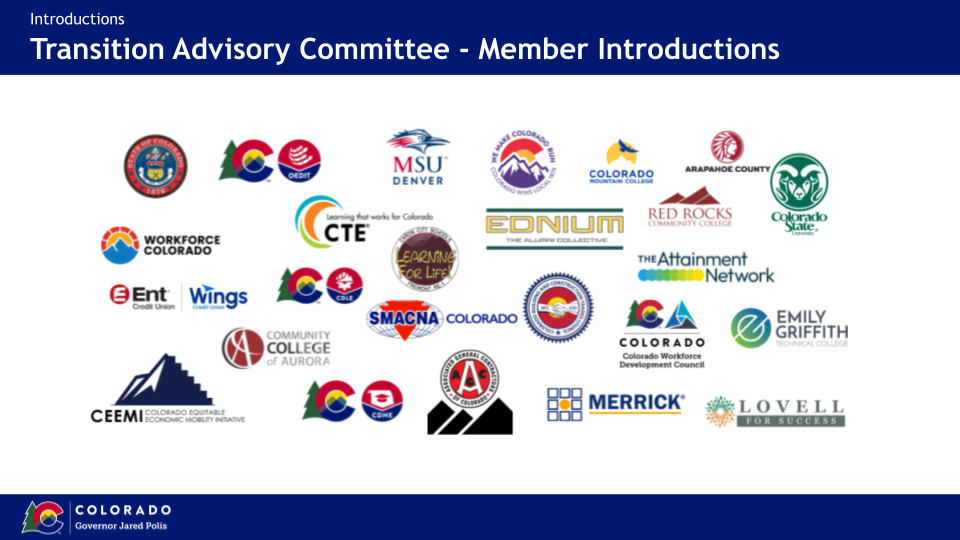
Earlier this summer, I was honored to be appointed vice-chair of the Transition Advisory Committee (TAC), established by House Bill 26-1317. The TAC’s work stems from a 2025 executive order and a subsequent report recommending ways to reimagine Colorado’s higher education and workforce systems to address our state’s talent gap. Our goal is to help create a more connected, outcomes-oriented system that leads to good jobs for Coloradans while meeting the talent needs of businesses. 


By November 30, the TAC must develop a transition plan with recommendations for a restructured state agency that streamlines higher education and workforce development efforts. I’m grateful to work alongside 26 other members representing state agencies, institutions of higher education, apprenticeship programs, organized labor, local workforce centers, nonprofit associations, and the business community. This breadth of perspective and expertise is essential to the work ahead. 


While we will address important tactical components, we recognize that large-scale systems change takes time. I want our plan and recommendations to provide a strong, supportive foundation that policymakers, educators, workforce development professionals, employers, and opportunity seekers can carry forward beyond 2026 as we continue building an outcomes-oriented system. 


The Governor’s Office and TAC members are also conducting extensive stakeholder engagement, and I hope you’ll be part of the conversation. You can: 


You’re also welcome to reach out to me at michelle@attainmentnetwork.org, and I can connect you with available members and resources. 

RECENT ARTICLES
August 10, 2026
The Career-Connected L/Earning Conference features more than 60 interactive sessions designed to help education, workforce, industry and community leaders strengthen career-connected pathways across Colorado and beyond. From innovative partnership models and emerging policy to practical tools you can put to work immediately, each session offers real-world strategies, lessons learned and opportunities to connect with peers tackling similar challenges. Here's a preview of some of the newest sessions added to the agenda: From Evidence to Impact: What It Takes to Scale Programs Well Learn what separates promising programs from those that achieve lasting impact at scale and explore practical strategies for expanding what works. Featuring: Nathaniel Riggs , Professor, Human Development & Family Studies and Executive Director of the Prevention Research Center, Colorado State University; Tiffany Madrid , Organizational Performance Management Supervisor, CDHS Postsecondary Employment Outcomes: Critical Data for L/Earners and Those Invested in Their Success Discover how national employment and earnings data can help educators, workforce leaders and learners make more informed decisions about education, training and career pathways. Featuring: Gina Johnson , Director, and Christopher Peña , Data Literacy Partner & Intern Supervisor, Postsecondary Employment Outcomes Coalition ; Benazir Rowe ; Junior Developer/Analyst, Front Range Community College When Credentials Cause Harm: Unpacking the Risks of Verifiable Learning and Work Records As digital credentials and verifiable learning records become more common, what unintended consequences should we be preparing for? Explore the opportunities, risks, and ethical considerations surrounding the future of learner records. Featuring: Dr. Kelly Page , LWYL Studios From Data to Action: Building Community-Driven Career Pathways See how communities are using shared data to identify workforce needs, strengthen partnerships and design career pathways that reflect local priorities. Featuring: Kelly Mitchell , Founder/ Principal, and Chris Mitchell, Data and Operations Consultant, Inclusive Design Group What It Takes to Scale: Turning Cross-Sector Partnerships into Workforce Pathways Learn how communities are building and sustaining workforce pathways through strong cross-sector collaboration and shared leadership. Featuring: Stacey Putka , Executive Director, Breakthrough ; Shalyn Kettering , Legal Counsel to the Colorado Attorney General; Clay McCombe , Program Manager, Power Ahead Colorado (a program of DRCOG) Outreach to Employment, By Design: How Commerce City and the Community College of Aurora Aligned Public Dollars Behind One Workforce System Discover how local leaders aligned funding, partnerships and workforce services to create a more coordinated system connecting residents to employment. Featuring: Emily Sanders , Senior Director of Collaborative Action, Rocky Mountain Partnership Cradle to Career ; Clair Collins , Vice President of Enrollment Success and Completion, Community College of Aurora; Sarah Mondesire, Community Well-Being Manager, City of Commerce City Grow Your Own: Navigating the Teacher Degree Apprenticeship Journey Hear firsthand from the partners and apprentices helping build Colorado's Teacher Degree Apprenticeship pathway and learn what's required to launch and sustain this innovative model. Featuring: MK Sagaria-Barritt CareerWise Colorado; Liz Qualman , Associate Dean of Education, Colorado Mountain College; Christina Randle: Educator Pathway Instructor, Harrison School District 2 Leveraging CTE Centers to Build CE Credential Pathways Explore how Career and Technical Education centers are expanding access to college credentials while creating stronger pathways into high-demand careers. Featuring: Shari Culver , Associate Dean, Arapahoe Community College; Dana Levesque , Coordinator of Postsecondary, Littleton Public Schools; Tara Bell , Director of Work-based Learning, Cherry Creek School District From Coursework to Workforce: Reimagining Teacher Preparation Through Career-Connected Learning See how industry experiences are helping prepare future educators to bring career-connected learning and workforce relevance into their classrooms. Featuring: Courtney Anderson , Education Department Chair, Community College of Aurora; Michelle Pacheco , Interim Vice President of Academic Success Community College of Aurora From Paycheck to Pathway: A Hands-On Workshop for Mapping On-the-Job Skills to Academic Credit Learn practical strategies for translating workplace learning into academic credit and creating more seamless pathways between employment and education. Featuring: Kim Eckert, Head of Instructional Innovation & Apprenticeship Design, Craft Education The Continuity Challenge: Tracing Durable Skills from PreK to Onboarding Explore how durable skills develop from early learning through workforce entry and identify practical strategies to strengthen career readiness across every stage of the learner journey. Featuring: Tim Taylor , Co-Founder and President, America Succeeds
August 3, 2026
It may be the dog days of summer, but our team is energized by the work ahead — bringing partners together, strengthening career-connected pathways, and helping shape systems that create more opportunity for learners and earners. From the San Luis Valley to Aurora to statewide leadership conversations, we're excited to keep collaborating with partners who are building Colorado's future. Here’s where you can find us this August: ๐Ÿ—“๏ธ August 10-11 ๐Ÿ”น Team Time – Denver Our work begins with a strong, high-functioning team. We're excited to come together to invest in the relationships, trust, and shared understanding that will help us collaborate and better serve our partners across Colorado. ๐Ÿ—“๏ธ August 12 ๐Ÿ”น Postsecondary Talent Development System Transition Advisory Committee – Denver Michelle Camacho Liu reconvenes with the Transition Advisory Committee to continue developing recommendations that will guide Colorado's new unified postsecondary talent development system. ๐Ÿ—“๏ธ August 13 ๐Ÿ”น Homegrown Talent Coalition Steering Committee Retreat – Denver Michelle and Stefan will join coalition leaders to align priorities and plan for the year ahead. ๐Ÿ—“๏ธ August 13-14 ๐Ÿ”น Colorado Project 2.0: San Luis Valley Regional Visit – San Luis Valley Part of the Colorado Project 2.0: Rural Renaissance initiative, this regional visit will bring together leaders and community partners to explore how rural innovation, collaboration, and impact-driven action are shaping Colorado's future. Rana will participate in conversations focused on policy, leadership, and regional solutions, while Ashley shares the story and impact of the San Luis Valley partnership. ๐Ÿ—“๏ธ August 21 ๐Ÿ”น Aurora Public Schools Health Science High School Pathways Professional Learning – Aurora Libby and other team members from The Attainment Network are partnering with Aurora Public Schools to build capacity among faculty and staff to support learners as they explore postsecondary pathways to in-demand healthcare careers. PD participants will engage with pathway experiences, connect with employer and postsecondary partners, and build career conversation skills to prepare learners for success beyond high school. ๐Ÿ—“๏ธ August 31 ๐Ÿ”น Career Advising and Navigation Partner Convening – Virtual Katherine, Michelle and other team members will come together with statewide partners to continue advancing our Career Advising and Navigation initiative and align on next steps for this growing body of work.
By Rana Tarkenton August 3, 2026
I recently spoke with a nonprofit leader navigating a difficult transition. For years, their organization had been recognized for its positive impact in the community. But when the longtime CEO departed, things began to get shaky. The reason? Much of the organization's influence, trust, and partnerships were tied to the CEO rather than embedded throughout the institution. The conversation stayed with me because I've spent my entire career in relationship-centered work. I believe deeply in the power of trust, partnership, and human connection. Some of the most meaningful progress I've seen in education and workforce development has happened because people chose to collaborate across organizations, sectors, and perspectives. Relationships matter. But relationships are not a strategy. And they are definitely not infrastructure. Healthy organizations need more than a CEO with strong relationships; they need connective tissue up and down the org chart. As I reflected on that conversation, I found myself asking a different question: If I stepped away tomorrow, would the work continue to thrive? I believe the answer is increasingly yes. Not because I'm unimportant, but because one of my most important responsibilities as a leader is to build an organization that is stronger than any one person's leadership, including my own. Leadership alone isn't enough. It takes people, systems, and shared ownership to turn relationships into lasting organizational strength. I say the same about The Attainment Network's role as a leader in the communities we serve. Our goal isn't to become indispensable. It's to help communities build the capacity, partnerships, and local infrastructure that allow the work to continue and grow long after our role has evolved. That same philosophy shapes how I think about leadership within our own organization. I’ve become increasingly intentional about stepping out of the middle. The more I’ve stepped out of the middle, the more I’ve watched our organization grow stronger. That has meant inviting team members into relationships and opportunities that I once managed myself and creating opportunities for them to lead. Today, the team leads the work, and I don’t need to be in the room all of the time. Our partnership leads have become trusted conveners in the communities they serve. Team members lead relationships with local and state partners — school districts, higher ed, state agencies, and others. They have become recognized experts in areas like data and evaluation, policy, apprenticeships, and emerging industries. Increasingly, our partners know exactly who to call, and it often isn’t me. None of that happened by accident. It happened because we made a conscious decision to forge relationships that belong to the organization, not to the CEO. One experience reinforced that lesson for me in a very personal way. Last year, I asked our policy lead, Michelle Camacho Liu, to represent The Attainment Network in the state's work to align the Colorado Department of Higher Education and the Colorado Department of Labor and Employment. She became our primary voice in those conversations, and she was invited to serve on the Governor's Transition Advisory Committee for that work. I was excited for her. At the same time, I had a fleeting moment of wondering what it meant that I wasn't invited. But then I caught myself and realized that the invitation wasn't evidence that I had become less valuable. It was evidence that our approach was working. She was invited to serve on the committee because she had become a trusted leader. Over months of thoughtful engagement, she built relationships, contributed meaningful expertise, and earned the confidence of the people at the table. As a CEO, I couldn't have asked for a better outcome. Of course, relationships are only part of the equation. Sustainable organizations also invest in the less visible work that creates resilience. We’ve strengthened our partnership model, refined governance and decision-making processes, invested in systems that support collaboration, knowledge sharing, and project management. None of those things make headlines, but together they create an organization that is more durable, more consistent, and less dependent on any one person. I've also learned that building distributed leadership requires letting go of the instinct to be at the center of everything. That's not always easy. Leaders often become leaders because they enjoy solving problems, building relationships, and creating momentum. Stepping back can feel uncomfortable at first. ๏ปฟ But I've discovered something surprising: there is tremendous satisfaction in watching your team become the people others call first. Their success isn't separate from yours. It is your success. I was reminded of this recently during a cross-sector convening in the San Luis Valley to begin building pathways to in-demand, high-paying careers in construction . We had prepared an agenda and talking points, expecting to facilitate much of the discussion. Instead, local employers, educators, workforce leaders, and community partners quickly took ownership. The conversation became theirs. Ideas emerged, commitments were made, and the momentum belonged to the people in the room rather than to us. As I looked around, I realized that was exactly the point. The strongest organizations and the strongest partnerships don't depend on one person to keep the work moving. They create the conditions for others to lead. Relationships will always matter. They are how trust begins. But lasting impact happens when that trust becomes shared leadership, strong systems, and local ownership. To me, that's what sustainable leadership looks like. It's not about making yourself indispensable. It's about building something that continues to grow because the relationships, the knowledge, and the leadership belong to the organization and the communities it serves.