Spotlight on our Board - Melanie D'Evelyn
Melanie D’Evelyn on cross-sector collaboration for economic mobility
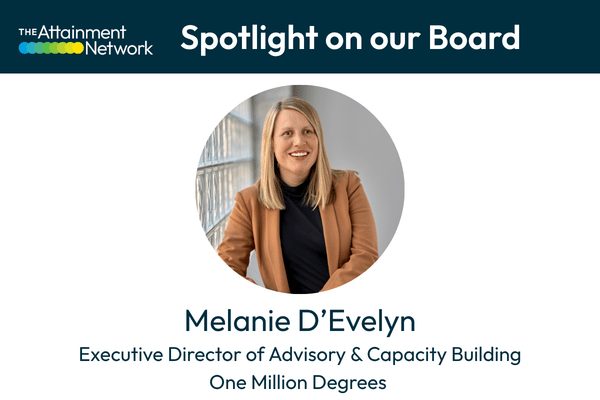
With experience spanning policy, philanthropy, and postsecondary success initiatives, Melanie D’Evelyn has worked at the intersection of systems change and student support. In this Board Spotlight, she reflects on what drew her to The Attainment Network, the experiences that shape her approach, and the opportunity to build more connected and durable pathways for learners.
Q: What inspired you to get involved with The Attainment Network, and why is expanding education and career opportunities for learners and earners so important to you?
The promise that education leads to economic mobility is nearly universal. Delivering on it — consistently, for everyone — remains one of the most important and stubbornly unresolved policy challenges we face. This is not a challenge any single organization or sector can tackle alone, and what drew me to The Attainment Network is that their cross-sector, collaborative approach isn't just a talking point. It's the organization's operating premise and it shows in how they partner.
There's also a personal dimension I can't separate from the professional one. My late father worked for the Colorado Department of Education — his plane went down on a work trip when I was young — and getting to support education policy and effective practice in Colorado, decades later, feels like a continuation of something he started.
Q: How have your personal or professional experiences shaped your understanding of the shifts needed in our education-to-workforce systems to better support learners and meet industry needs?
Before returning to Colorado four years ago, I worked in Detroit leading a cross-sector collaborative of business, philanthropic, K-12, and university leaders around shared education and workforce goals. The stakes were concrete: only 13% of the city's population held a bachelor's degree. Mentoring individual students through college applications and financial aid, I saw how easily they got lost. That experience sharpened my conviction that wraparound support has to be built into the system, not layered on as an afterthought. It's what I carried into my current work at One Million Degrees, where I now support 16 community colleges across four states with exactly that mission.
Q: What’s a piece of career advice you’ve received that still sticks with you, and who offered you that advice?
Early in my career, I was mentored by Egil "Bud" Krogh, who walked through his own ethical failures and dedicated the rest of his life to promoting ethics in government and education. He said: "integrity is the key quality in one's life." The wisdom of holding yourself accountable to how things get done as well as what gets done has stuck with me.That conviction carried into the work itself; Bud and I partnered with colleges and high schools across the country to bring that message to students at the start of their own careers.
Q: Looking ahead, what excites you most about the future of The Attainment Network and its impact on learners, earners, and entire communities across the state?
What excites me most is the potential to build on the bright spots that already exist — connecting them into something more durable and systemically coordinated, so pathways are less fragmented and students can successfully move through them. The Attainment Network is uniquely positioned to be that connective tissue across the state and, increasingly, across the mountain west.
Q: What book is on your bedside table? Would you recommend it? Why or why not?
I just finished The Correspondent and thought it was wildly fun!
RECENT ARTICLES